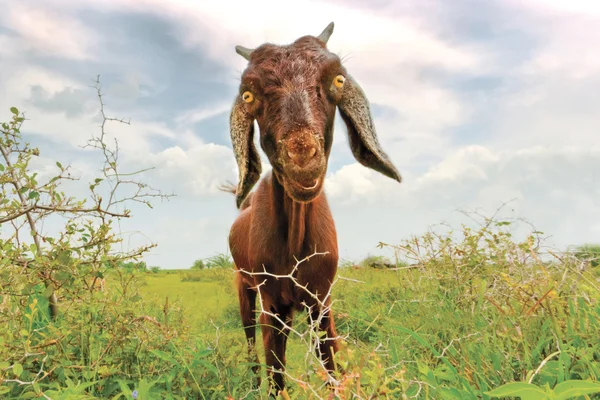
Imagine standing in a bustling farmyard, the air thick with the scent of hay and earth, as a curious goat trots up to you. Its big eyes lock onto yours, but something seems off – maybe a slight grimace or a tense ear twitch. As a kid growing up on my uncle’s small farm in the Midwest, I spent summers helping with the animals, and goats were always the trickiest. They’d butt heads for fun but hide their aches like pros. Little did I know back then that technology would one day step in to decode those subtle signals. Today, scientists have built an AI that literally gazes into goat faces to spot pain, revolutionizing how we care for these quirky creatures. It’s not just about cute farm stories; this tech could change animal welfare forever.
The Origins of Goat-Focused AI
This groundbreaking AI didn’t pop up overnight – it stemmed from a real need in veterinary science. Researchers at the University of Florida noticed how hard it is to tell when goats are hurting, especially since they don’t whine like dogs or cats. Led by Dr. Ludovica Chiavaccini, the team decided to harness machine learning to automate pain detection, drawing from similar tools used for other animals.
The project kicked off when a graduate student fell in love with goats after showcasing them at an ag show. That passion fueled a study that filmed dozens of goats in various states, creating a dataset ripe for AI training. It’s funny how one person’s goat obsession can lead to tech that helps thousands of animals worldwide.
What Is This AI All About?
At its core, this AI is a deep learning model that scans goat faces for telltale signs of discomfort, like flared nostrils or a raised lip. It’s designed to process video frames quickly, making it practical for farms or vets. Unlike human observers who might miss cues due to bias or fatigue, the AI spots patterns objectively.
The system classifies faces as “in pain” or “not in pain” based on thousands of images, achieving impressive results without needing perfect conditions. Think of it as a digital vet’s assistant that never gets tired. And while it’s goat-specific now, the framework could adapt to other livestock.
How the AI Detects Pain in Goats
The magic happens through a pipeline that extracts frames from raw videos and analyzes them using pre-trained neural networks. Researchers used a VGG-16 base combined with a support vector machine for classification. This setup allows the AI to learn from real-world messy footage, not just lab-perfect shots.
In testing, it handled variations in breeds, ages, and lighting, proving its robustness. Dr. Chiavaccini jokes about chasing goats with cameras, highlighting how the AI overcomes human limitations in chaotic environments. It’s like giving vets superpowers to read animal emotions instantly.
Training the Model: From Farm to Algorithm
To build this, the team videotaped 40 goats at a veterinary hospital, capturing over 5,000 frames from animals with conditions like bladder stones. They labeled each based on clinical exams and behavior scales, then split the data for training and testing. The balanced approach – using 80% for training and 20% for fine-tuning – yielded the best results.
This method repeated five times to average out variances, ensuring reliability. It’s akin to cramming decades of vet experience into minutes of computing. The result? An AI that’s 80% accurate on average, far surpassing guesswork.
Accuracy and Testing: Numbers That Matter
Accuracy ranged from 62% to 80%, depending on the testing split, with the optimal model hitting 80% consistently. They tested on unseen goats to mimic real use, proving it generalizes well. Compared to human experts, it reduces subjectivity, though it’s not perfect yet.
Future tweaks aim to boost that number with more data. For now, it’s a solid start, especially since no general goat pain scale existed before. Farmers could use apps linked to this tech for daily checks.
Why Detecting Goat Pain Matters
Goats might seem tough, but untreated pain hits their welfare hard – think reduced appetite or slower growth, which affects farm productivity too. This AI steps in to catch issues early, potentially saving lives and cutting costs. It’s emotional too; remembering my uncle’s goat that suffered quietly from an infection tugs at the heartstrings.
Beyond farms, it promotes ethical animal husbandry. As someone who’s seen the bond between farmers and their herds, I know this tech could strengthen that trust. Plus, happier goats mean better milk or meat for us all.
Implications for Animal Welfare
In broader animal care, this AI sets a precedent for non-invasive monitoring. It could alert farmers via phone apps if a goat looks distressed, enabling quick vet calls. Organizations like the ASPCA might integrate it into welfare standards.
The emotional appeal is strong – no one wants animals suffering in silence. By automating detection, we make compassion scalable. It’s a win for ethics and efficiency alike.
Potential for Human Medicine
Surprisingly, goat pain tech could help humans, especially non-verbal patients like kids or those with dementia. The AI’s ability to work with imperfect images solves issues in human tools, where lighting or angles often fail. Dr. Chiavaccini notes that vet challenges mirror medical ones.
This crossover excites researchers, potentially leading to better pain management in hospitals. It’s wild how staring at goats might ease human suffering – talk about unexpected connections.
Comparison: AI vs. Traditional Pain Detection Methods
Traditional methods rely on manual scales, where vets score behaviors like ear position or activity levels. These are time-consuming and subjective. AI, on the other hand, processes data in seconds with consistent results.
| Method | Speed | Accuracy | Cost | Scalability |
|---|---|---|---|---|
| Manual Vet Assessment | Slow (minutes per animal) | Varies (human bias) | High (labor) | Low (one at a time) |
| AI Facial Analysis | Fast (real-time) | 62-80% (improving) | Low (once built) | High (farm-wide) |
As shown, AI edges out in efficiency, though humans still excel in complex cases. Combining both could be ideal.
Pros and Cons of AI in Goat Pain Detection
Let’s break it down honestly.
Pros:
- Quick and objective analysis reduces missed diagnoses.
- Scalable for large herds, aiding busy farmers.
- Builds on data, improving over time with more inputs.
- Non-invasive, no need for stressful exams.
Cons:
- Initial accuracy isn’t 100%, risking false positives.
- Requires tech setup, like cameras, which costs upfront.
- Limited to faces; misses body language cues.
- Data privacy concerns if integrated with cloud services.
Overall, the pros outweigh cons for modern farming, but it’s not a silver bullet.
Best Tools for Animal Pain Detection
If you’re a farmer or vet eyeing this tech, start with open-source AI frameworks like TensorFlow for custom models. For ready-made, check apps like PainChek for humans, adaptable to animals. Veterinary software from Idexx integrates AI diagnostics.
For goats specifically, the UF model’s code might become available post-study. Best bet: Collaborate with universities for pilots. Tools like these make pain management accessible.
Where to Get More Information on Goat AI Tech
Head to the University of Florida’s College of Veterinary Medicine site for study details (external link: UF Vetmed). The full paper is in Scientific Reports (external link: Nature Article).
For related reading, our site’s animal tech section has guides on AI in farming (internal link: /animal-ai-guides). Join forums like Reddit’s r/Veterinary for discussions.
People Also Ask
How do you know if a goat is in pain?
Goats show pain through subtle signs like grimacing, ear flattening, or reduced activity. Watch for changes in eating or social behavior too. This AI helps by quantifying these cues objectively.
Can AI detect emotions in animals?
Yes, AI like this one detects pain as an emotion indicator in goats, and similar systems work for cats or sheep. It’s based on facial action units, much like human emotion AI.
What is the goat grimace scale?
The goat grimace scale scores facial features for pain, validated mainly for young males. This AI expands it to all goats, automating the process for broader use.
Why is AI used in veterinary medicine?
AI speeds up diagnoses, reduces costs, and improves accuracy in areas like imaging or pain assessment. It’s especially useful for silent sufferers like livestock.
FAQ
What accuracy does the goat pain AI achieve?
The model hits an average of 80% accuracy in detecting pain from facial expressions, tested on diverse goats. It varies by method but outperforms random guessing significantly.
How was the AI trained for goat faces?
Researchers filmed 40 goats, extracting over 5,000 frames labeled as pained or not. They used deep learning to train the model, fine-tuning for real-world variability.
Can this AI be used for other animals?
Absolutely – the framework applies to sheep, cats, or even cows with adjustments. Studies on sheep pain AI show similar success, paving the way for multi-species tools.
Where can I access this goat pain detection technology?
Currently, it’s research-based, but contact UF for collaborations. Future apps might emerge; check veterinary tech hubs like VetCandy for updates.
Is AI better than humans at spotting goat pain?
In consistency and speed, yes, but humans add context. The combo is powerful – AI flags issues, vets confirm.
Wrapping up, this AI gazing into goat faces isn’t just a novelty; it’s a leap toward kinder, smarter animal care. From my farm days to today’s tech, it’s heartwarming to see innovation bridge that gap. If you’ve got goats or love animals, this could be the future – efficient, empathetic, and endlessly fascinating.