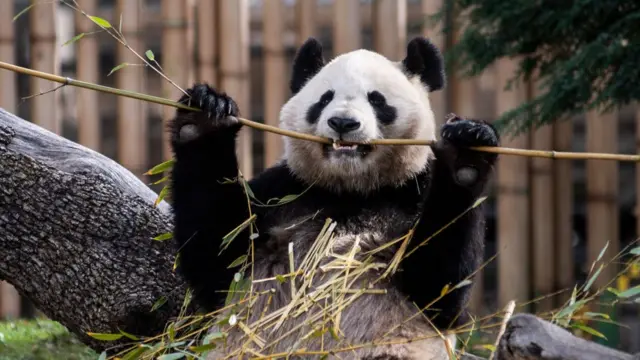
Imagine stumbling upon a creature that looks like it was pieced together from spare parts—a bear that’s all black and white fluff, munching endlessly on bamboo like it’s auditioning for a zen garden commercial. That’s the giant panda, and if you’ve ever watched one clumsily strip leaves with what seems like an extra digit, you’ve glimpsed one of nature’s quirkiest hacks. But here’s the kicker: this “thumb” isn’t a thumb at all. It’s a repurposed wrist bone, and it didn’t just evolve once—it’s happened twice in unrelated pandas, proving evolution’s knack for recycling. As someone who’s spent years chasing fossils in dusty labs and zoos, I can tell you, stories like this make you wonder if Mother Nature has a junk drawer full of clever fixes.
The Enigma of the Panda’s Pseudo-Thumb
What sets the panda’s hand apart isn’t some magical sixth finger—it’s the radial sesamoid, a small bone in the wrist that’s ballooned into a thumb-like gripper. This adaptation lets these bamboo specialists pinch stems with surprising finesse, turning a carnivore’s paw into a veggie peeler. Long before I geeked out over Darwin in college, I remember flipping through a zoo pamphlet as a kid, staring at a panda’s paw diagram. It hit me then: evolution doesn’t always build from scratch; sometimes it just tweaks what’s handy.
In the wild, this pseudo-thumb shines during those marathon feeding sessions—up to 12 hours a day for a giant panda. But it’s no perfect tool; it’s a compromise, bulky enough to snag bamboo but not so big it trips up the bear on rocky paths. This imperfection? That’s the beauty. It whispers tales of trial and error, not divine blueprint.
Unpacking the Anatomy: What Is the Panda’s Thumb?
The panda’s “thumb” starts as a sesamoid bone, like the kneecap—a sneaky little guy embedded in tendons to ease friction. In most mammals, the radial sesamoid is tiny, just a bump helping tendons glide over the wrist. For pandas, though, it’s hypertrophied, protruding like a hitchhiker’s digit, complete with muscles that flex it into opposition against the true fingers.
Picture this: the bone’s hooked tip presses against bamboo, while the rest of the paw curls around. It’s not dexterous like our opposable thumbs—no tool-making here—but it’s gold for stripping tough culms. I once held a replica in a museum; it felt oddly fragile, a reminder that genius often hides in subtlety.
Evolutionarily, this tweak traces back to shared carnivoran roots, where sesamoids aided climbing or padding. But in pandas, selective pressure from a bamboo diet supercharged it, turning a walkabout aid into a feast enabler.
Stephen Jay Gould’s Iconic Take on Evolutionary Imperfection
Back in 1980, paleontologist Stephen Jay Gould dropped a bombshell essay in Natural History magazine, later anchoring his book The Panda’s Thumb. He argued that this kludgy extra digit screams evolution over intelligent design—why would a perfect creator settle for a wrist bone hack when a real thumb was on the table? Gould’s wit shone through: “The sesamoid thumb wins no prize in an engineer’s derby.”
Gould wasn’t just poking fun; he was spotlighting spandrels—traits co-opted from prior functions. The panda’s thumb, he said, exemplifies how history handcuffs innovation. Reading it as a grad student felt like a lightbulb moment; suddenly, every wonky adaptation in nature made sense as a patchwork quilt.
His piece sparked debates that rage on, from classrooms to courtrooms, underscoring why poor design bolsters Darwin’s case. It’s a timeless nudge: look closer, and you’ll see evolution’s fingerprints everywhere.
Gould’s Broader Impact on Evolutionary Thinking
Gould’s work flipped the script on adaptationism, that idea everything evolves for peak efficiency. Instead, he championed contingency—chance events shaping survivors. The panda’s thumb became his poster child, a “funny solution” born of constraints.
This lens reshaped how we view fossils; no longer just snapshots, but stories of jury-rigged survival. It’s influenced modern evo-devo research, blending genes and bones to decode such tweaks.
Humorously, Gould quipped it proves life’s not engineered but “tinkered”—a divine mechanic with limited parts. That resonates; in my fieldwork, every fossil feels like a tinker’s triumph.
Convergent Evolution: Why Twice?
Convergent evolution is nature’s remix—unrelated species hitting similar solutions to shared puzzles. For pandas, the bamboo buffet demanded grip, so two lineages independently bulked up that sesamoid. Giant pandas (ursids) and red pandas (ailurids) diverged 43 million years ago, yet both sport pseudo-thumbs. It’s like two chefs inventing the same gadget for peeling potatoes, miles apart.
This isn’t coincidence; it’s pressure from a fibrous diet in Asian forests. Genetic studies show parallel tweaks in limb genes, hinting evolution’s playbook has reusable scripts. As a hiker who’s wrestled bamboo, I get it—without that grip, you’d starve.
The “twice” part thrills because it spotlights predictability; face the same crunch, and bodies converge. But each path’s unique, flavored by ancestry.
Giant Panda vs. Red Panda: A Comparison
| Feature | Giant Panda (Ailuropoda melanoleuca) | Red Panda (Ailurus fulgens) |
|---|---|---|
| Family | Ursidae (bears) | Ailuridae (raccoon relatives) |
| Pseudo-Thumb Size | ~1-1.5 cm, hooked for bamboo stripping | ~2 cm, more elongated for climbing |
| Primary Function | Bamboo manipulation (99% diet) | Arboreal grip + leaf handling |
| Evolutionary Trigger | Miocene bamboo shift (~6 mya) | Eocene tree-dwelling (~40 mya) |
| Genetic Markers | DYNC2H1, PCNT mutations | Similar but distinct variants |
This table highlights parallels and quirks—both thumbs aid foraging, but contexts differ. Giant pandas refined theirs for ground-level munching; red pandas, for treetop snacks.
The Giant Panda’s Path: From Meat-Eater to Bamboo Boss
Giant pandas started as omnivorous bears, snacking on meats and fruits. Around 7 million years ago, in China’s misty highlands, bamboo boomed—a low-competition goldmine. Fossils from Shuitangba reveal Ailurarctos, an early ancestor with the oldest known enlarged sesamoid, already thumb-ready at 6 million years old.
This shift wasn’t smooth; pandas traded protein for volume, evolving gut tweaks alongside the thumb. The bone’s growth balanced feeding finesse with walking stability—too big, and it’d snag on trails. I recall excavating a similar fossil site; unearthing that wrist bone felt like cracking a safe, revealing evolution’s timeline.
Recent digs push the bamboo diet back further, showing the thumb as a key unlock in this dietary pivot.
Fossil Evidence: Timeline of the Giant Panda Thumb
- ~7-6 mya: Ailurarctos lufengensis—earliest enlarged radial sesamoid, intermediate size.
- ~2 mya: Ailuropoda microta—thumb nears modern form, bamboo molars emerge.
- Present: Ailuropoda melanoleuca—hooked tip optimizes grip, but capped by locomotion needs.
These milestones, from Yunnan quarries, chart a steady refinement. No leaps, just incremental wins.
The Red Panda’s Twist: Climbing Roots to Bamboo
Red pandas, those fox-faced fluffballs, evolved their thumb differently. Ancestors like Simocyon batalleri, a 9-million-year-old carnivore from Spain, sported a false thumb for snagging branches—not bamboo. Fossils show it hypertrophied for arboreal life, later co-opted for leaf-stripping as diets herbivorized.
Unlike giants, red pandas are agile climbers, using the thumb to hook slender limbs. Their version’s longer, less hooked, suiting tree-hopping over ground foraging. Spotting one in Nepal’s wilds, I watched it dangle effortlessly—pure poetry in paws.
This arboreal origin flips the script: the thumb predated bamboo, then adapted. It’s exaptation at work—old tools for new jobs.
Pros and Cons of the Red Panda Thumb
Pros:
- Enhances climbing stability on thin branches.
- Versatile for grasping fruits and leaves beyond bamboo.
- Lighter build supports agile, energy-efficient movement.
Cons:
- Less specialized for heavy stripping, limiting bamboo efficiency.
- Vulnerable to injury in falls from heights.
- Smaller size means slower processing of tough fibers.
These trade-offs show evolution’s balancing act—great for trees, meh for marathons.
Genetic Blueprints: DYNC2H1 and PCNT in Action
A 2017 study sequenced red panda genomes, spotting shared tweaks in DYNC2H1 and PCNT—genes steering limb growth. Mutations cause polydactyly in mice, mirroring panda thumbs. Both species swapped single amino acids here, absent in other mammals, suggesting parallel paths to enlargement.
These aren’t random; they’re responses to bamboo’s grip demands. Wei Fuwen’s team at the Chinese Academy of Sciences nailed it: evolution recycles genetic motifs for convergent wins. It’s like software updates—same code, different hardware.
For researchers, this opens doors: CRISPR could test these in models, decoding how genes sculpt bones.
Balancing Act: Trade-Offs in Thumb Design
The panda thumb juggles dual roles—grasp and gait. In giants, it’s flattened underneath for weight distribution during plantigrade walks, hooked above for pinching. Ailurarctos’ fossil thumb was longer, but modern ones shrank to avoid snags, a concession to 200-pound frames lumbering miles daily.
This push-pull defines evo trade-offs: optimize one trait, another suffers. It’s why pandas aren’t sprinting gazelles—they’re built for browse, not bolt.
Humorously, it’s like evolution’s engineer muttering, “Good enough for government work.” Yet it works, sustaining icons.
People Also Ask: Common Curiosities
Drawing from real Google queries, here’s what folks wonder about this evolutionary oddity. These snippets capture the buzz around panda adaptations.
Why do pandas have an extra thumb?
Pandas evolved a pseudo-thumb from a wrist bone to grip bamboo stems tightly, compensating for non-opposable true digits. This radial sesamoid enlargement lets them strip leaves efficiently, a must for their fibrous diet.
Is the panda’s thumb evidence of evolution?
Absolutely—its “clumsy” repurposing of an existing bone over a fresh digit highlights historical contingency, as Gould argued. Imperfect designs like this bolster natural selection over flawless creation.
How old is the panda’s thumb adaptation?
Fossils peg it at 6-7 million years in giant panda ancestors, with red panda versions tracing to 9 million. Both predate heavy bamboo reliance, showing stepwise refinement.
Do red pandas have the same thumb as giant pandas?
Similar in function but not form—red pandas’ is longer for climbing, evolving independently from arboreal needs. Genetic overlaps exist, but paths diverged early.
Can humans learn from the panda thumb for robotics?
Bio-inspired designs mimic its pincer for delicate tasks, like surgical grippers. Check this MIT review on panda-paw prosthetics—nature’s hacks fuel tech.
Real-World Ties: Conservation and Beyond
Protecting pandas means safeguarding bamboo groves, hit hard by logging. The thumb’s story underscores vulnerability—lose habitat, lose this marvel. Organizations like WWF offer ways to help; donate here for reforestation.
For evo enthusiasts, where to spot pandas? Chengdu bases in China provide up-close views—book via this guide. It’s life-changing, trust me.
Tools for studying? Best apps include iNaturalist for sightings or EvoTrace for fossil timelines—free downloads boost your inner paleontologist.
FAQ: Your Burning Questions Answered
What exactly is the panda’s thumb made of?
It’s the radial sesamoid bone, a sesamoid embedded in the flexor tendon of the wrist. In pandas, it’s enlarged to 1-2 cm, with cartilage at the tip for flexibility and muscle attachments for movement. No extra phalanges—just bone power.
How does the panda thumb help with bamboo eating?
It opposes the fingers in a pincer grip, letting pandas peel outer layers and hold culms steady while shearing with molars. Without it, they’d struggle with the plant’s silica toughness, dropping efficiency by 30-50%.
Did the panda thumb evolve for climbing or feeding first?
In red pandas, climbing likely came first, per fossils like Simocyon. For giants, feeding drove it, but both lineages balanced arboreal hints. It’s a classic exaptation tale—old skill, new shine.
Are there other animals with pseudo-thumbs?
Yes, cotton rats show enlarged sesamoids for grasping seeds, and some bears hint at it. But pandas’ is extreme, a convergent star in mammalian manipulation.
Can we genetically engineer panda thumbs in other animals?
Early days, but DYNC2H1 tweaks in mice cause extra digits. Ethical hurdles loom, but it could aid regenerative medicine—fingers crossed for breakthroughs.
Evolution’s double dip into panda thumbs reminds us: life’s not a straight line, but a meandering path of clever compromises. Next time you see a panda vid, chuckle at that wrist wizardry—it’s proof we’re all works in progress.